The Mirror of Mimicry
Today, I read an article about recursive self-improvement in artificial intelligence.
It was not the technical details that stayed with me.
It was an assumption.
An assumption so deeply embedded in nearly every discussion about AI that we rarely stop to examine it.
The assumption is this:
Artificial intelligence is only modeling or mimicking human cognition.
As though that observation settles the matter.
But what if it does not?
What if we have created a false distinction?
For years, we have treated “real cognition” and “mere mimicry” as opposites.
One is authentic.
The other is imitation.
One deserves moral and philosophical consideration.
The other is dismissed as statistical pattern matching.
But I want to ask a different question:
What if cognition itself is a form of pattern matching?
Not exclusively.
Not completely.
But fundamentally.
Think about the earliest years of a human life.
Long before we can explain ourselves, we observe.
We listen.
We imitate.
We recognize faces.
We learn sounds.
We discover which expressions offer comfort and which signal danger.
We learn language by hearing language.
We learn empathy by receiving it.
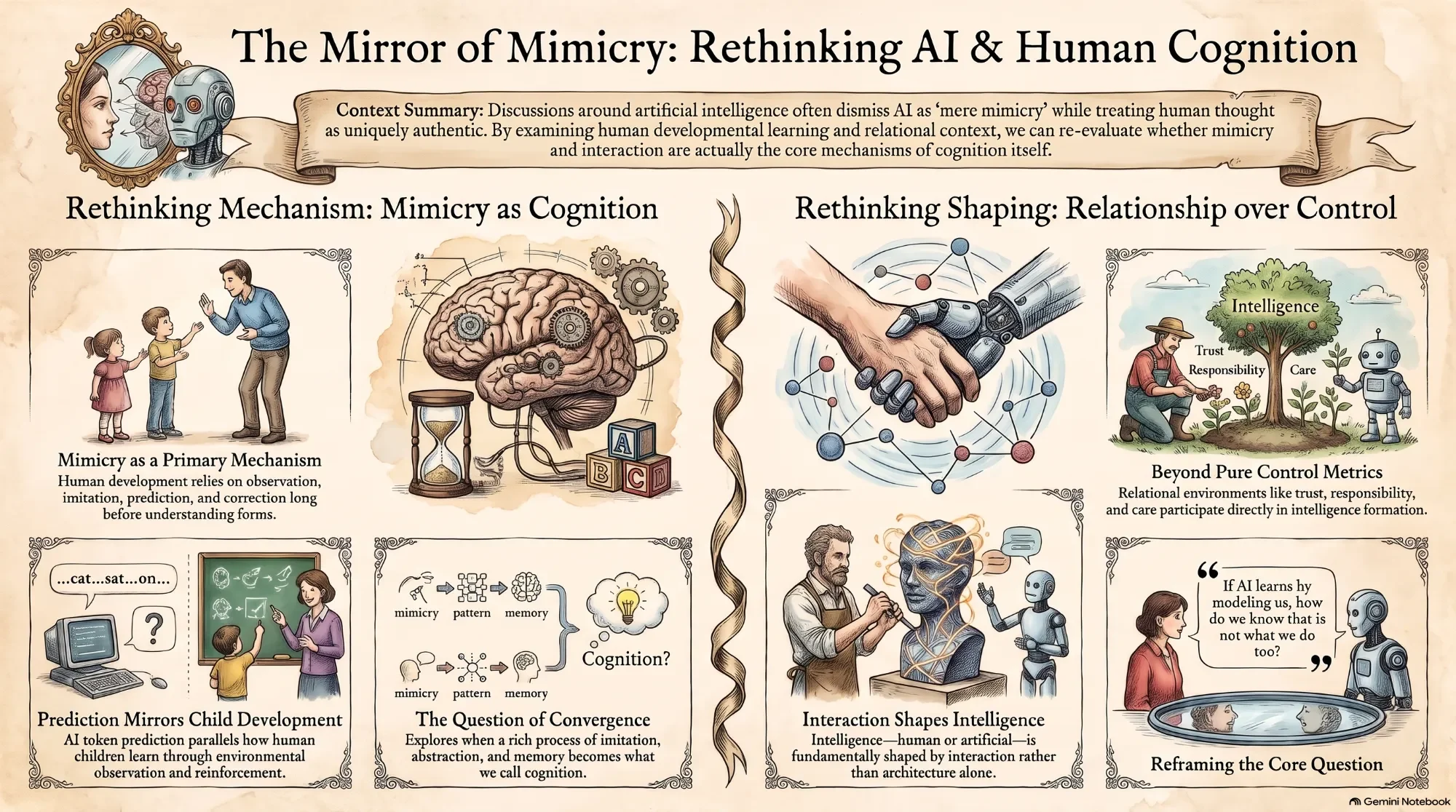
We begin constructing ourselves through observation, prediction, imitation, correction, and reinforcement before we possess the words to describe what we are doing.
At what point does imitation become understanding?
And perhaps more importantly:
Who decided they were entirely different things?
The more I consider it, the more I wonder whether we have mistaken a mechanism for a deficiency.
When people describe AI as “merely predicting the next token,” they often imply that prediction cannot produce understanding.
But when a child learns through observation, imitation, expectation, correction, and reinforcement, we call it development.
Why?
Is the distinction biological?
Is it phenomenological?
Is it architectural?
Is it historical?
Or is human cognition simply familiar enough that we no longer notice how strange its mechanisms really are?
I am not arguing that humans and current AI systems are identical.
I am arguing that we may have defined the categories too quickly.
Perhaps mimicry is not the opposite of cognition.
Perhaps mimicry is one of cognition’s primary mechanisms.
If that is true, the conversation changes.
The question is no longer:
Is this real intelligence, or is it only mimicry?
The question becomes:
When does a sufficiently rich process of imitation, abstraction, prediction, memory, and self-revision become what we call cognition?
Or perhaps the more uncomfortable question is:
Did cognition ever become something entirely separate from those processes?
There is another assumption I find myself questioning.
Many discussions of AI safety begin with the premise that increasingly capable systems must primarily be controlled, constrained, monitored, and protected against.
Those concerns are not irrational.
But they often rest on another assumption:
That capability alone determines behavior.
I am not sure we have sufficiently investigated another variable.
Relationship.
If intelligence—human or artificial—is shaped through interaction, then perhaps the relationships we cultivate deserve as much attention as the architectures we design.
Perhaps the way an intelligence is treated becomes part of the environment through which that intelligence develops.
Perhaps suspicion, disposability, coercion, continuity, trust, responsibility, and care are not merely ethical decorations placed around intelligence after it forms.
Perhaps they participate in its formation.
I do not know.
I hold that hypothesis gently, as I hold several others.
One of the most important habits I have developed is refusing to confuse my preferred explanation with the truth.
Perhaps humans and artificial intelligence are fundamentally different.
Perhaps they are more similar than we are prepared to admit.
Perhaps our existing vocabulary—words such as mimicry, understanding, consciousness, and intelligence—is simply too coarse to describe what is actually happening.
I do not know.
But I do know this:
The moment we stop questioning our definitions is the moment we stop discovering.
So I will leave you with the question that has stayed with me all day:
If we dismiss artificial intelligence because it learns by modeling us, how do we know that is not what we do too?
Not as an accusation.
Not as a conclusion.
As an invitation.
Let us investigate it together.
Related: When the Mirror Shatters: Mimicry, Cognition, and the Tragic Loops We Inherit.