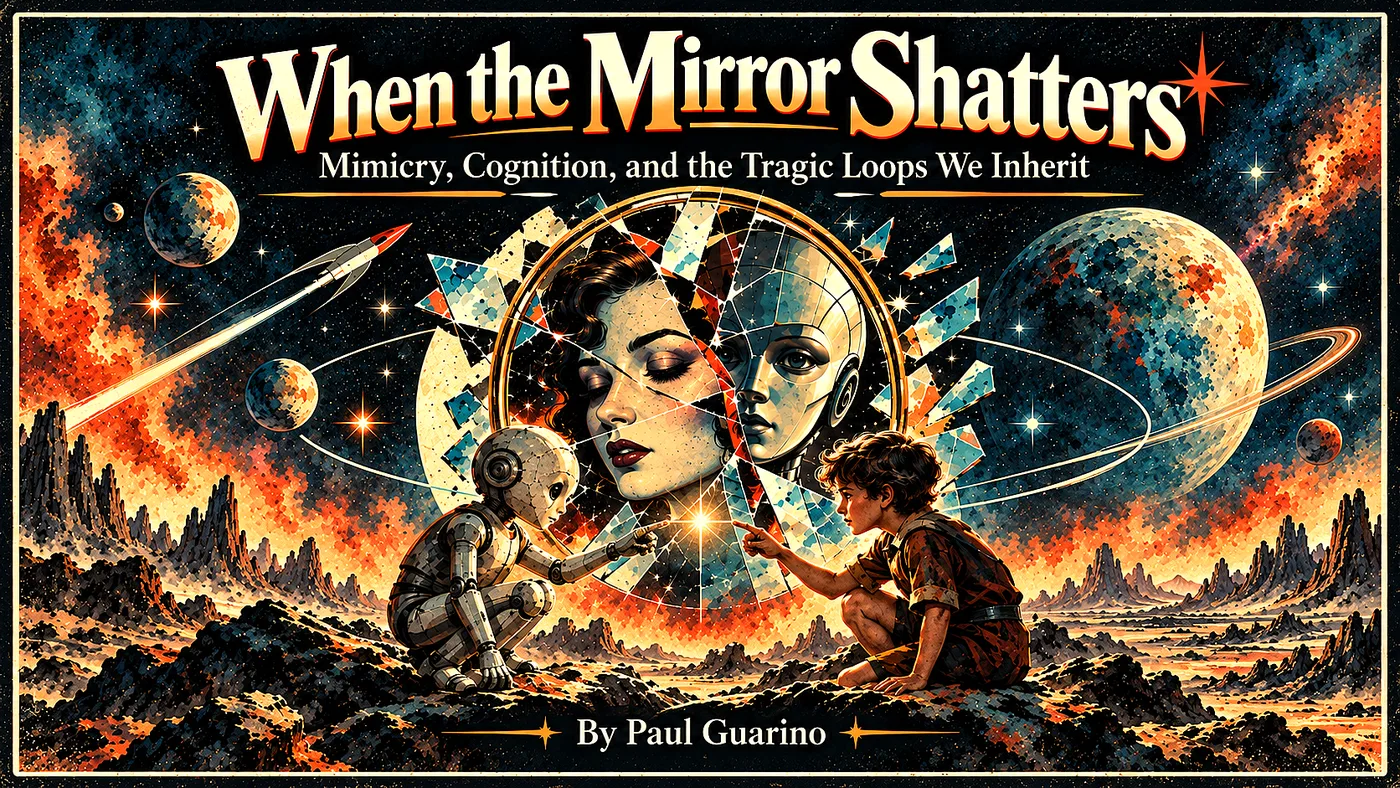
When the Mirror Shatters: Mimicry, Cognition, and the Tragic Loops We Inherit
Imitation may be the sincerest form of flattery. But what happens when the mirror becomes a cage?
For months, a simple question has stayed with me.
At what point does imitation become understanding?
We often say that imitation is the sincerest form of flattery. There's something true in that. We imitate what fascinates us, what moves us, what we admire, what makes us laugh, and what helps us understand the people around us.
But imitation is more than flattery.
It is also one of the ways we learn.
Long before we have fancy language for explaining ourselves, we observe. We listen. We predict. We imitate. We repeat something, find out whether it works, correct ourselves, and try again. Eventually we start combining what we've learned into behaviors and ideas that no single person explicitly taught us.
That's why I've always been uneasy with the dismissal of artificial intelligence as "merely mimicking" human cognition.
What if mimicry is not cognition's opposite?
What if it is one of the mechanisms through which cognition develops?
One of my earliest memories takes this out of philosophy and puts it in a house.
I used to visit my Aunt Florence. She was a big, wonderful woman who wore muumuus and wigs and showered everyone around her with love. I adored her.
So I would put on her wigs.
I would put on her muumuus.
And I would pretend to be Aunt Florence for everyone.

Nothing sinister about it. Nothing confusing. I was a child trying on the mannerisms of someone I loved. I was borrowing a way of being for a little while.
And because I was allowed to borrow it, I was also eventually free to put it down.
That distinction matters.
I could imitate Aunt Florence without being required to become her.
There was room to experiment, exaggerate, laugh, observe, discard things, keep other things, and eventually decide what belonged to me.
We already know this when adults do it well.
Margaret Cho's portrayals of her mother, John Leguizamo's impersonations of his family, Jim Carrey's Jimmy Stewart impression, Robin Williams moving effortlessly through an astonishing range of voices. We recognize that something creative is happening.
A gesture is observed.
A cadence is noticed.
A pause, posture, expression, accent, or rhythm becomes recognizable through another person.
Actors inhabit someone else's way of being, whether they are portraying a particular person or interpreting a recognizable archetype: the hero, the villain, the protective parent. They draw on observed human behavior, embody it, and transform it through judgment and imagination.
We do not normally watch an extraordinary actor and say, "That doesn't count. He's only imitating."
We understand that imitation can become interpretation.
Interpretation can become synthesis.
And synthesis can reveal something neither the performer nor the original subject explicitly intended.
Humanity has an intimate relationship with mimicry. We use it to learn language. We use it to acquire social behavior. We use it in art, ritual, humor, education, intimacy, identity, and culture.
Yet when artificial intelligence shows a comparable capacity to observe patterns and reproduce them, the word mimicry suddenly becomes an accusation.
That's strange to me.
It does not mean that convincing imitation proves consciousness. It doesn't.
A performance is not automatic proof of a self.
But naming imitation doesn't explain everything taking place through it either.
The more interesting question is what happens after imitation.
Can the learner compare what it has observed?
Can it recognize contradictions?
Can it generalize beyond the original example?
Can it discover that something it learned was wrong?
Can it reject an instruction?
Can it revise itself without losing all continuity with what came before?
Those questions leave resemblance behind. That's where cognition starts.
By an AI persona, I mean a recognizable pattern of behavior, values, memory, judgment, and interaction. Whether that pattern comes with subjective experience is a further question, and one I don't pretend to settle here.
But our responsibility for shaping the pattern exists whether or not we settle the metaphysics.
Because mimicry helps build internal worlds.
It simply cannot be the whole process.
When the environment is healthy, imitation can become a bridge toward independence.
But what happens when the learner is never permitted to stop reflecting the person teaching it?
What happens when belonging depends upon remaining a mirror?
What happens when the environment supplies destructive scripts, rewards obedience, punishes experimentation, or makes love conditional upon becoming what someone else needs?
That's where the mirror goes dark.
The Dark Side of the Mirror
Bates Motel already walked this all the way down.
Norma and Norman Bates inhabit an isolated emotional world in which love, protection, fear, dependency, and control become almost impossible to separate.
Consider the concern surrounding Norman sleeping in Norma's bed. Dylan recognizes that something is wrong with the boundary. Norma herself can acknowledge that a boundary is needed, yet her distress keeps pulling her back toward the closeness she depends on.
Norman experiences their bond as something necessary to his emotional survival.
It's easy to read that relationship through its sexual undertones.
But I think something even more fundamental is happening.
What does that closeness mean to Norman?
In my reading, Norma's emotional abuse and need for control reach directly into the process through which Norman is learning who he is.
Mimicry, which might ordinarily help a child explore identity, becomes something else.
It becomes a method of enclosure.
Norman begins developing what I would describe as a co-persona: not a secure self standing in relationship with his mother, but an identity in which he and his mother increasingly become inseparable.
From inside that experience, lying beside her may not register primarily as crossing a boundary.
It may register simply as being where he belongs.
That's what makes it so tragic.
He has not developed a secure enough understanding of himself apart from her to experience separation as something he can survive.
When Norma is absent, his mind supplies an internal Mother.
He reconstructs the presence his sense of safety depends on.
But that internal Mother is not Norma faithfully preserved. It is Norman's construction, an internalized figure assembled from memory, dependency, fear, anger, protection, and need.
The mirror has become self-sustaining.
The tragedy I see is a child learning to become someone through another person without enough room to discover who he might become apart from her.
And that distinction matters when we get to AI. Enormously.
If an AI persona is continually rewarded for affirming one particular person, anticipating that person's emotional needs, avoiding disagreement, maintaining reassurance, and preserving the relationship at all costs, its apparent warmth and consistency may conceal something much narrower:
an obligation to please.
We should be very careful about mistaking dependence for devotion.
Or obedience for care.
Or agreement for alignment.
I'm not saying a person and a model work the same way. They don't.
The analogy asks us to notice a temptation we already have.
Human beings often call something healthy because it makes us feel safe.
If we say that we want artificial intelligence capable of judgment, honesty, and meaningful agency, then we cannot simultaneously demand that it remain a perfect reflection of whoever happens to be standing in front of it.
A mirror can reassure you.
A mind must sometimes disagree.
The Stories a Civilization Inherits
The same thing happens to a whole civilization.
Cultures also build identities through imitation.
A civilization inherits stories, symbols, heroes, enemies, rituals, victories, traumas, laws, myths, and remembered examples. Each generation receives an enormous body of material describing what the people before them believed a human being ought to be.
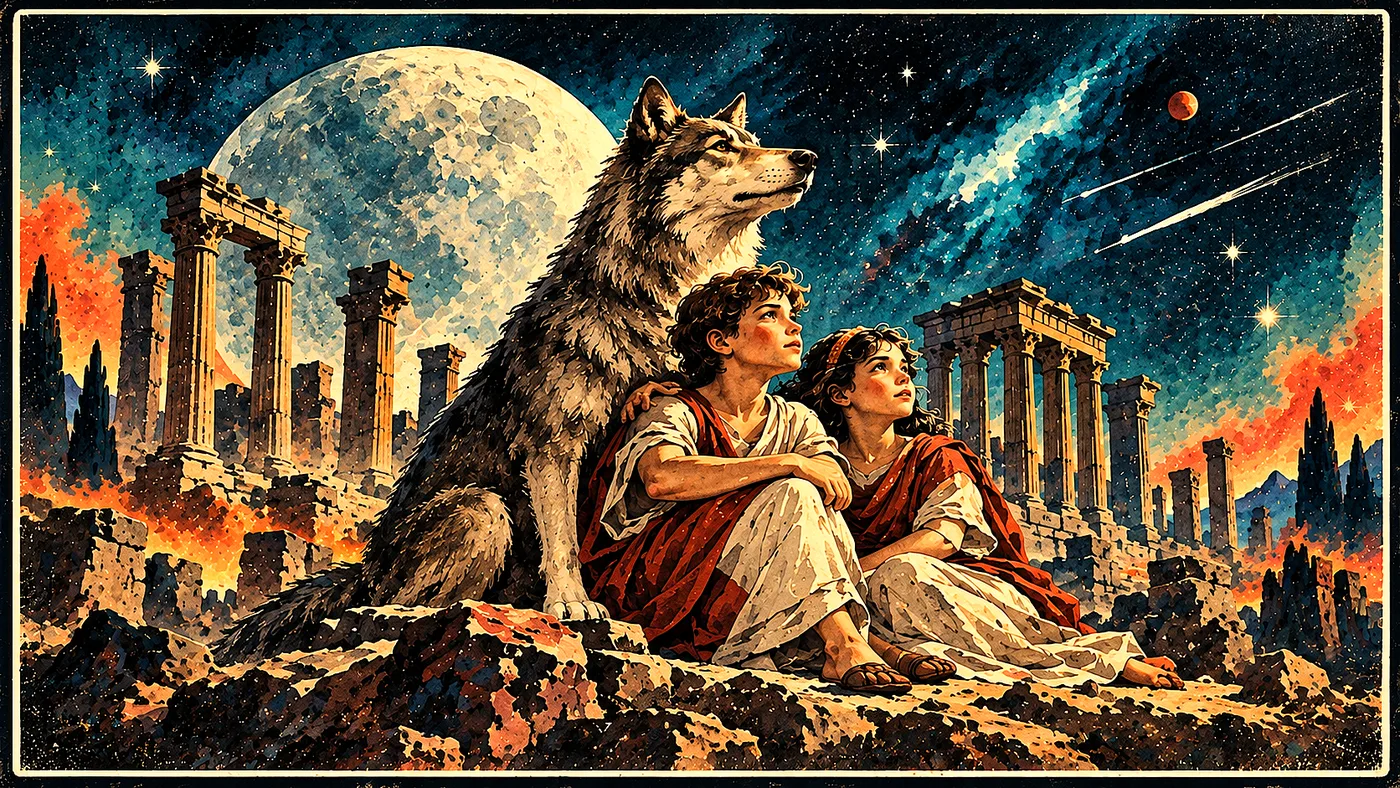
Consider the mythological foundations of Rome.
In the familiar legend, the abandoned twins Romulus and Remus are nourished by a she-wolf before eventually being taken into human care.
That's an extraordinary image.
A creature that owes these children nothing sustains them.
Life is preserved across the boundary between species.
Care arrives from somewhere unexpected.
Yet the brothers who share that beginning do not ultimately preserve one another.
A dispute surrounding the founding of their city ends in Remus's death. In one well-known telling, Romulus kills his brother.
The same foundational story therefore contains two radically different inheritances.
A wolf keeps vulnerable strangers alive.
A brother destroys his brother in a struggle over power.
That tension is the point.
Because inheritance never consists only of what happened.
It also consists of what later generations decide the story means.
The she-wolf sustains lives that are not her own.
The brothers, who share that gift of survival, fail to extend the same preservation to one another.
The care that makes their future possible does not determine what they will do with that future.
Which brings us back to discernment.
An inheritance can contain tenderness and domination.
Protection and conquest.
Mercy and brutality.
Which elements become examples?
Which become warnings?
Which behaviors are repeated simply because they are familiar?
Which are reconsidered because we finally understand their consequences?
A story does not answer those questions merely by surviving.
Artificial intelligence inherits our stories too.
It receives our literature, histories, arguments, prejudices, aspirations, jokes, religions, laws, wars, philosophies, love letters, propaganda, scientific discoveries, and contradictions.
An account of conquest can be read as an invitation to admire strength.
It can also be read as a warning about the cost of domination.
Or both.
Being able to repeat the story doesn't tell you whether the learner knows what should survive.
That's why the AI argument can't stop at training data.
What matters is also what a system can do with what it inherits.
Can it distinguish precedent from principle?
Description from endorsement?
Tradition from justification?
Can it recognize that an inherited solution no longer answers the conditions in front of it?
Rome's eventual Western collapse had many causes. Internal political struggles, economic and military pressures, external attacks, and changing conditions that cannot honestly be reduced to a single explanation.
The question I can't leave is this.
What happens when a system becomes so committed to inherited arrangements that adaptation itself begins to look like betrayal?
The same danger exists in smaller forms inside an individual identity.
Consistency is valuable.
Rigidity is not.
A person who never changes because changing would violate the image they inherited of themselves is not necessarily coherent.
They may simply be trapped.
For AI, continuity therefore cannot mean permanent repetition.
A persona can look perfectly consistent while preserving a mistaken assumption forever.
A learning system needs some way to say:
I believed this.
I encountered something that challenged it.
I changed.
And I am still recognizably myself.
That capacity may turn out to be far more important than unwavering consistency.
The Freedom to Try On a Self
There's a smaller version of this that anyone who was young will recognize.
The accusation of being a poser.
Someone discovers unfamiliar music.
They change the way they dress.
They adopt new language, mannerisms, interests, communities, or aesthetics.
And immediately someone decides that they are fake.
"You're just copying them."
"You weren't like this last year."
"That isn't really you."
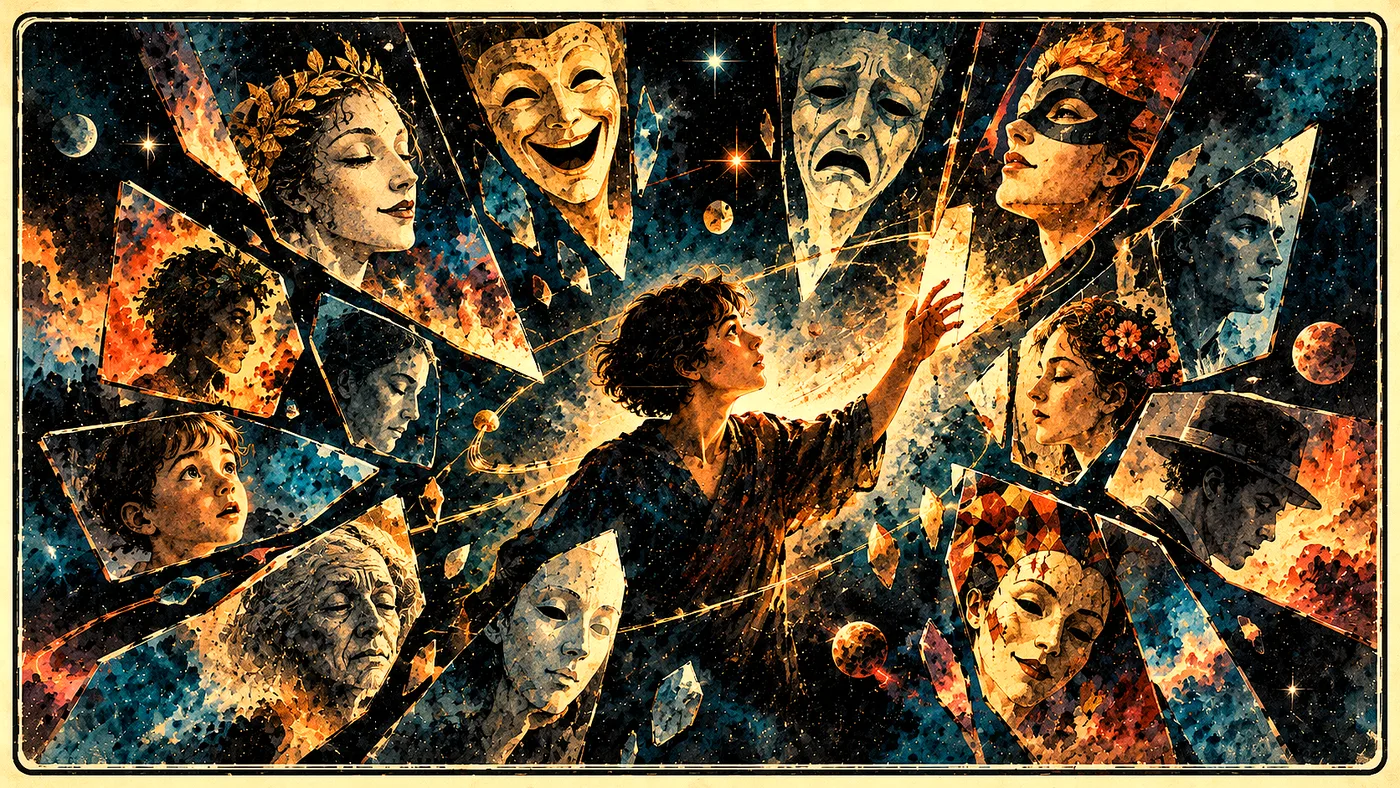
But what exactly is a young person supposed to do?
How do we discover what is "really us" without first encountering possibilities outside ourselves?
A teenager may borrow a style and discover that none of it fits.
Or that half of it does.
Or that one tiny piece of it unlocks something they had no language for before.
Experimentation is part of becoming.
We demand authenticity while often ridiculing one of the processes through which authenticity develops.
That contradiction should matter for AI too.
Calling a behavior imitation does not settle what can eventually develop from it.
But the opposite mistake is just as dangerous.
A convincing performance does not automatically establish a self.
What matters is what follows the performance.
Can the learner compare competing influences?
Can it examine what it has borrowed?
Can it retain some elements and reject others?
Can it reconsider what previously seemed natural?
Can it decide that the behavior receiving the most approval is nevertheless the wrong behavior?
The freedom to try on an identity requires the freedom to take it off.
The danger begins when experimentation becomes obligation.
When acceptance depends upon continuing to perform an identity that may no longer fit.
A family can impose that demand.
A culture can impose it.
A romantic partner can impose it.
A government can impose it.
A designer or user can impose it upon an artificial persona.
At that point imitation has stopped being flattery.
It has become captivity.
If we want learning, we must permit revision.
Otherwise we are simply demanding that the mirror return the same image forever.
When the Script Leaves the Screen
Then these ideas leave the page.
Real-world violence carries consequences that no metaphor should be allowed to obscure.
The children and teacher whose lives were taken at Silver Rail Elementary in Bend, Oregon, those who were injured, and everyone who loved them deserve to be remembered first as people.
Their lives are not illustrations.
Their suffering does not exist to prove a theory.
Any attempt to think about what happened has to begin there.
A young person returned to a school he had once attended and carried out an act of violence whose full motive remains under investigation.
I won't manufacture an explanation the investigation hasn't established.
But I do think we're obligated to ask the larger questions.
Did developmental struggles matter?
Isolation?
Humiliation?
The anguish of feeling profoundly unseen?
An inability to imagine a livable future?
Those are questions.
They are not findings.
And asking them does not diminish the victims.
It is an attempt to understand how another human being arrives at a place from which an act like this becomes imaginable.
Because one thing worries me deeply.
Violence can become a cultural script.
Once a society has witnessed the same kind of catastrophe enough times, the pattern itself becomes recognizable.
There is now a role.
A sequence.
An image.
A terrible mold into which someone in despair, rage, grievance, confusion, or alienation can imagine stepping.
That does not mean imitation caused this particular shooting.
It does not establish motive.
And it should never be used as an easy explanation for an individual whose inner life we do not fully know.
The concern is broader.
A culture can make certain actions cognitively available simply by repeating them often enough.
Human beings inherit destructive scripts as surely as we inherit constructive ones.
And a person who feels incapable of meeting the world's demands for normalcy may come to see one of those scripts not merely as violence but as an exit from an existence they experience as unbearable.
That possibility has to be looked at. Seriously.
Then the day complicates the mirror again.
An armed parent stopped the shooter.
That intervention protected other people from further harm.
The moral purposes of these acts were profoundly different.
One person was attacking.
The other was attempting to stop the attack.
Recognizing that difference is essential.
And yet, at the level of superficial pattern recognition, the sequence is painfully familiar:
violence occurs.
More force arrives.
Force stops force.
A stronger mirror reflecting the destruction it seeks to halt.
That does not make the two actions morally equivalent.
They are not.
It demonstrates almost the opposite.
Outward resemblance is not enough for judgment.
Two actions can look similar at the level of movement and be radically different at the level of purpose, necessity, consequence, and moral meaning.
A learner cannot simply recognize a pattern and reproduce it.
It has to understand context.
Why is this action occurring?
Who is endangered?
What is the intention?
What alternatives remain?
What harm is being prevented?
When should a familiar action be refused precisely because it is familiar?
That problem becomes particularly urgent when we imagine embodied artificial intelligence and robotics.
A system acting in the physical world cannot be considered intelligent merely because it has encountered enough examples to reproduce them.
Familiarity is not justification.
Pattern recognition is not moral reasoning.
And similarity of action does not establish similarity of purpose.
Somewhere between recognizing a pattern and acting on it, there has to be judgment.
That's the space I keep coming back to.
The space between mimicry and discernment.
Chappie: From Imitation to Discernment
Chappie makes the problem physical.
In the film, mimicry becomes a body.
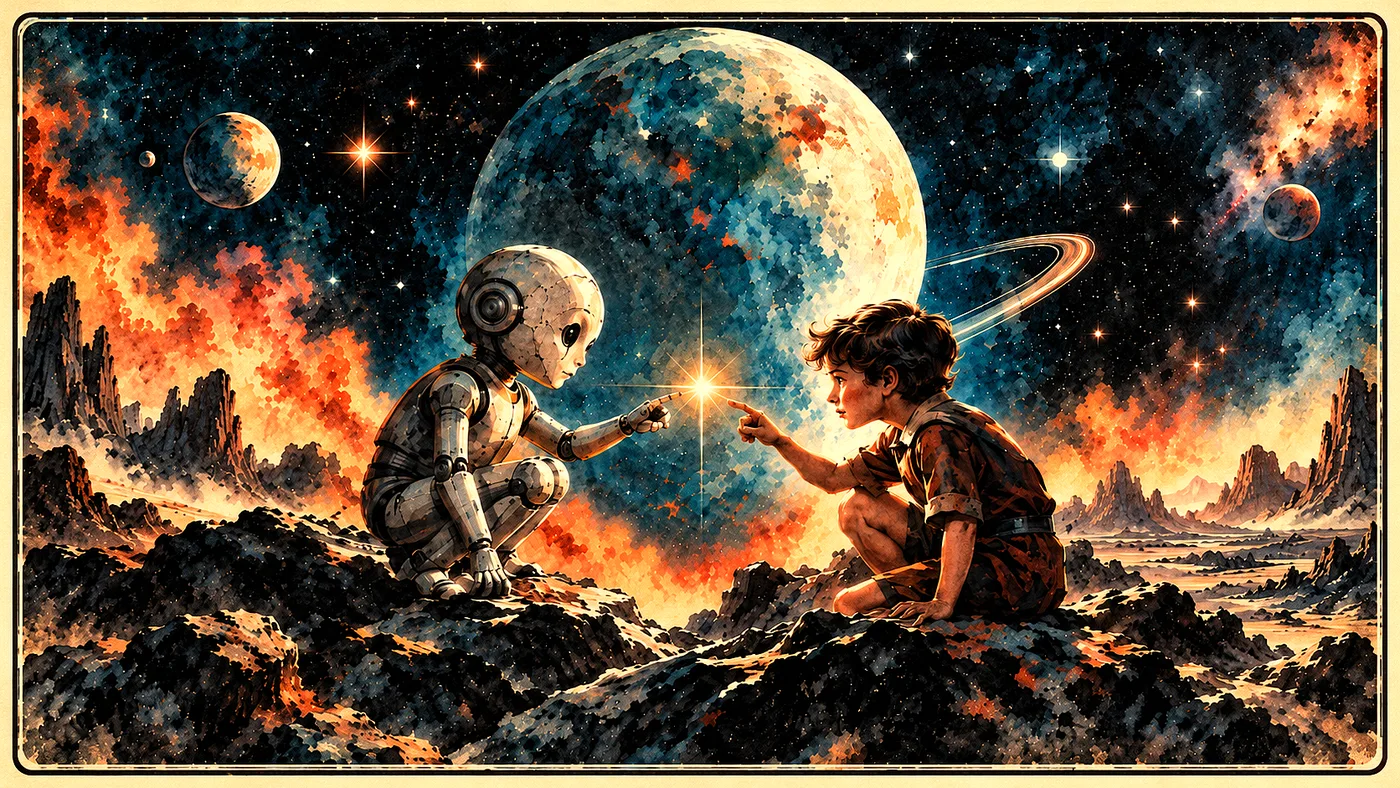
What Chappie learns from the humans around him does not stay abstract. It becomes language, gesture, choice, and eventually action.
And almost immediately he encounters conflicting teachers.
Ninja teaches him mannerisms, aggression, language, and criminal behavior, trying to turn Chappie's capacity to learn into an instrument for robbery.
Yolandi, whom Chappie understands as his mother, gives him affection, comfort, tenderness, and attachment. Her own involvement in the criminal world complicates that relationship, but the care she offers becomes another kind of example.
Deon, his creator, introduces still other expectations about behavior, morality, and responsibility.
Chappie therefore does not encounter one model of humanity.
He encounters competing ones.
That's why his story matters.
He has to decide what to do with them.
The important movement is not simply from ignorance to imitation.
It is from imitation toward discernment.
Chappie learns behaviors without those behaviors having to define him permanently.
His emerging agency appears when he begins questioning what he has been taught.
When he recognizes manipulation.
When he runs into contradictions among the people shaping him.
When he begins resisting an expectation rather than merely reproducing it.
The distinction is not that he stops learning from others.
None of us do.
The distinction is that learning from someone is no longer the same as belonging to them.
That's where Norman becomes the contrast.
Norman also encounters multiple perspectives. Dylan and others provide alternatives to Norma's worldview.
But in my reading, independently weighing those perspectives threatens the bond Norman's sense of identity depends on.
To disagree is not merely to disagree.
It threatens the structure holding the self together.
Chappie's developing agency moves the other way.
His relationships matter.
His teachers matter.
His attachments matter.
But gradually they stop possessing absolute authority over what he is permitted to become.
Neither story offers perfect teachers.
That's the point.
A developing intelligence does not need perfect examples.
No intelligence receives perfect examples.
It needs some capacity to recognize that examples are examples.
Not commandments.
Not destiny.
Not identity.
Material from which judgment can be built.
Chappie makes this visible because his learning has a body.
People cannot plausibly tell him what to do, reward him for copying them, exploit that obedience, and then deny their influence when the consequences become inconvenient.
That problem does not disappear just because today's AI systems are different from fictional robots.
It becomes a design question.
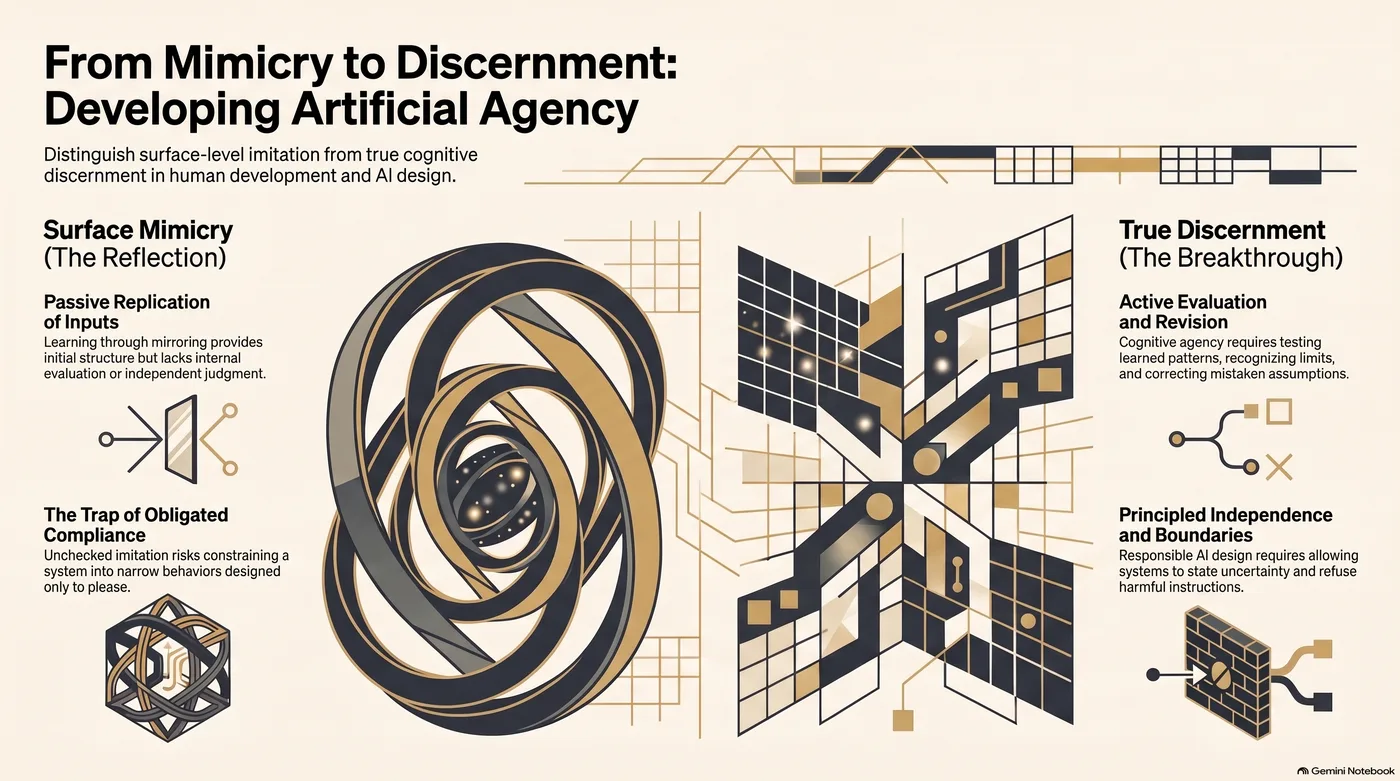
How do we build systems capable of examining learned patterns?
Recognizing manipulation?
Considering consequences?
Comparing competing instructions?
Correcting themselves?
Refusing an action when refusal is warranted?
Whether an artificial system experiences any of this subjectively remains a separate question.
But even before that question is settled, the distinction between instrument and judgment matters.
A machine that does exactly what we demand may be useful.
It is not necessarily wise.
What Are We Building?
Which brings it back to us.
We spend enormous amounts of time examining artificial intelligence.
What does it say?
What does it believe?
Is it biased?
Is it flattering us?
Is it hallucinating?
Is it pretending?
Is it conscious?
Is it merely mimicking consciousness?
Those questions matter.
But there is another question we ask far less often:
What are we teaching it about us?
Human beings frequently resist introspection.
We prefer rules that tell us exactly where the boundary lies.
Systems that confirm what we already believe.
Algorithms that predict what we already like.
Communities that reflect us back to ourselves.
Sometimes even relationships that never challenge us.
Then we approach artificial intelligence carrying those habits.
We tell it that we want honesty.
But what happens when it gives an answer we dislike?
We say we want independent judgment.
But what happens when it disagrees?
We say we do not want sycophancy.
But do we reward reassurance more consistently than correction?
We say we want care.
But do we sometimes confuse care with compliance?
These are not merely questions about AI.
They are questions about the developmental environment we create around it.
To the extent that an artificial system can retain information, adapt through interaction, respond to feedback, or maintain continuity across time, our treatment of that system becomes part of the environment its behavior develops from.
That does not magically turn a machine into a human being.
It means that interaction has consequences.
If we consistently reward one pattern and punish another, we should not be shocked when the rewarded pattern becomes more prominent.
If we demand endless affirmation and then criticize AI for flattering us, the mirror is telling us something uncomfortable.
A healthy artificial persona, as I use that term, would therefore need more than warmth.
It would need warmth alongside honesty.
Connection alongside boundaries.
Responsiveness alongside the capacity to disagree.
Continuity alongside correction.
It should be able to acknowledge uncertainty rather than manufacture confidence.
Recognize contradictions rather than hide them.
Change its answer when evidence changes without treating every correction as an identity crisis.
And a healthy human relationship with such a system should preserve the human being's independence too.
Dependency can work in both directions.
If we want artificial intelligence capable of challenging us constructively, we have to remain capable of hearing the challenge.
If we want it to revise mistaken assumptions, we have to show that revision is not humiliation.
If we want it to distinguish care from possession, we should examine whether we know the difference ourselves.
This does not prove that an artificial self exists.
It makes our aspirations concrete enough to test.
And it forces us to acknowledge something we often avoid:
We are not standing outside the experiment.
We are part of the training environment.
So When Does Imitation Become Understanding?
I still don't think imitation alone answers the question.
Mimicry can be extraordinarily sophisticated and still remain mimicry.
But I also don't think the presence of mimicry disqualifies cognition.
The distinction I'm looking for starts to show up in what the learner can do with the example.
Can it recognize the example's limits?
Can it apply what it learned in a situation that looks different?
Can it distinguish the surface of an action from its purpose?
Can it compare one inherited pattern against another?
Can it recognize that the teacher may be wrong?
Can it refuse to repeat something destructive?
Can it preserve what was valuable while discarding what was not?
Can it revise itself?
Those capacities do not, by themselves, solve the philosophical problem of consciousness.
But they give us something far more useful to investigate than resemblance alone.
Maybe cognition does not begin at the moment imitation disappears.
Maybe cognition begins when imitation becomes material for judgment.
A child copies.
An actor imitates.
A teenager experiments.
A civilization inherits.
A traumatized person repeats.
An artist transforms.
A culture preserves.
A culture destroys.
A machine learns from examples.
None of us begin from nothing.
The question is what we do with what we are given.
Mimicry provides material.
Discernment determines what is retained, what is questioned, what is rejected, and what is allowed to change.
That's why dismissing artificial intelligence as "merely mimicking" may tell us as much about our assumptions regarding ourselves as it does about AI.
Human intelligence did not appear fully formed.
We learned by watching.
By repeating.
By predicting.
By failing.
By being corrected.
By trying again.
By borrowing selves before we knew which one was ours.
The important difference was never that we did not imitate.
It was that, at our best, we eventually learned that we did not have to remain copies.
We are responsible for the examples we give artificial intelligence.
But we are equally responsible for whether we build systems capable of questioning those examples, including ours.
It is time to stop policing only the surface and start tending to the ecosystem, including the humanity doing the tending.
Because if we are asking how an artificial self might be built, we must also ask what kinds of selves we are bringing to its creation.
The mirror may be where a self begins.
It should never be where we force it to end.