The Cost of Fragmented Compute
Elevation and the Case for a Unified Coherence Stack
Right now, while you are reading this, your compute infrastructure may be losing power and performance it will never recover.
Not in some theoretical future stress scenario. Today. In your current fleet. In thermal-throttle events that reduce throughput across an entire device. In DRAM refresh cycles governed by worst-case assumptions rather than measured retention. In signal workloads sent to expensive accelerators even when they can be processed elsewhere. In AI outputs that must be reviewed, regenerated, or rejected because the system cannot determine whether they are trustworthy.
The loss rarely announces itself as a single catastrophic failure. It accumulates quietly—kilowatt by kilowatt, rack by rack, quarter by quarter—until infrastructure purchased to create a competitive advantage becomes more expensive to operate than it needs to be.
That is the cost of fragmented compute.
And it begins with a problem the industry still treats as four separate problems.
The Constraint Is Coordination
The organizations that lead the next era of accelerated computing will not necessarily be the ones with the most GPUs. They will be the ones that extract the greatest usable performance from the infrastructure they already own.
Raw hardware capacity is only part of the equation.
The deeper constraint is coordination.
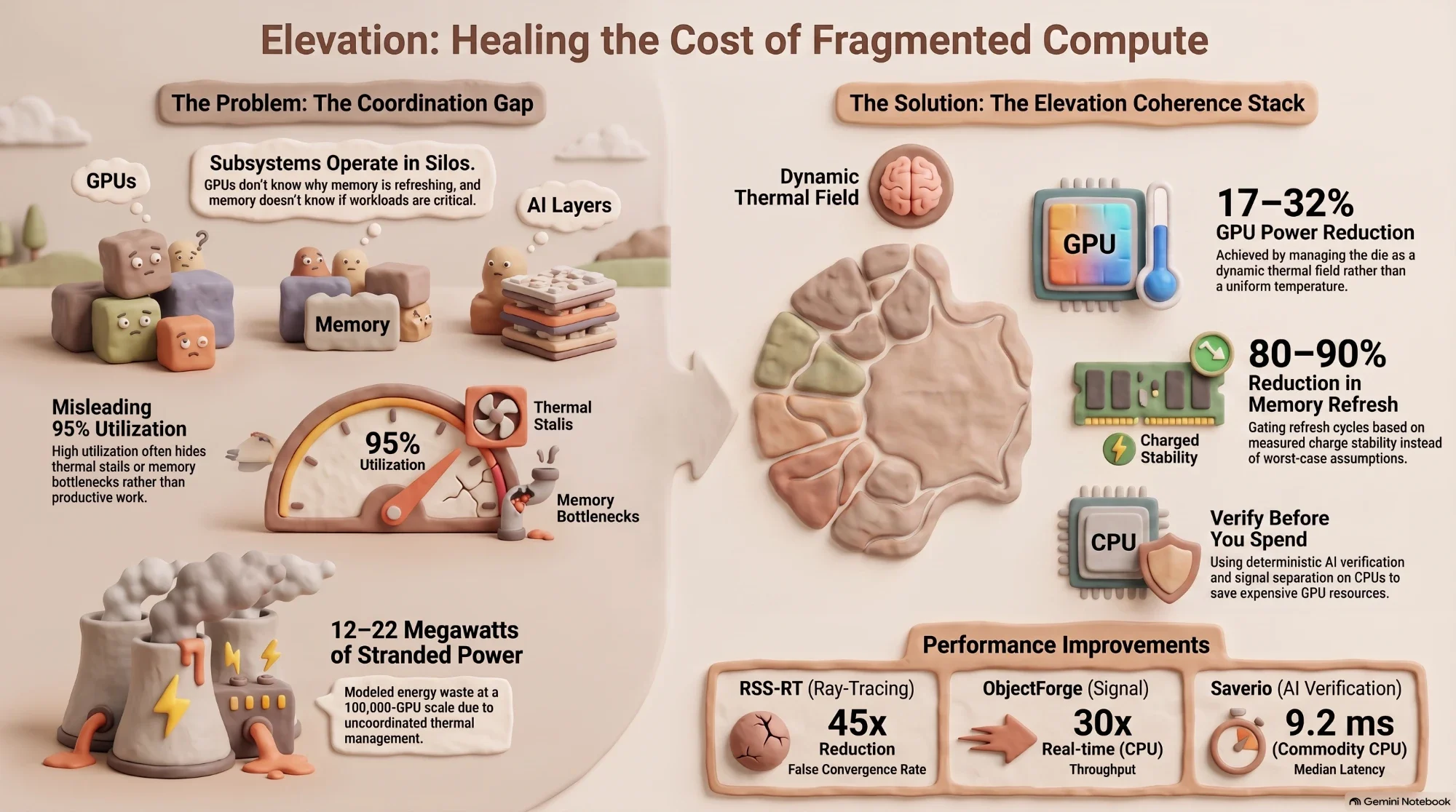
The GPU does not know why memory is refreshing. Memory does not know whether the workload is stalled, transient, or critical. The signal pipeline consumes whatever compute it is allocated. The AI layer produces outputs that must then be trusted, checked, rejected, or repaired—often by still more computation.
Each subsystem is managed as though it operates alone.
It does not.
Heat changes memory behavior. Memory behavior changes GPU load. Signal-processing decisions determine how much specialized hardware is required. AI verification determines whether the result can be used at all.
What appears on a dashboard as four separate engineering problems is one connected loss of coordination—and operators pay for that loss at every layer.
Elevation was designed to address that structural gap.
What Elevation Is
Elevation is a unified coherence technology stack for graphics, entertainment, and accelerated-compute infrastructure. It applies one deterministic measurement framework across four layers that are normally optimized independently:
- GPU thermal and utilization management
- DRAM and HBM refresh management
- Real-time signal separation
- AI-output verification
This is not four unrelated products gathered beneath a common name. It is one architectural proposition:
Measure what is actually happening at each layer before spending power, surrendering performance, or accepting an output.
At the scale of 100,000 H100-class GPUs, the modeled opportunity associated with fragmented thermal management is 12 to 22 megawatts.
That estimate is not presented as a completed production deployment. It is the scale of the opportunity the GPU architecture is designed to test through a controlled pilot on relevant hardware.
The next step is not belief.
It is measurement.
The First Loss: You Think You Know What 95% Utilization Means
Ask a conventional monitoring stack what is happening when GPU utilization reads 95 percent. It will tell you that the GPU is busy.
It may not tell you whether that figure represents compute-bound work running at full throughput, memory-bound work waiting on bandwidth, or a thermal stall in which the device is hot, throttled, and producing output below its rated performance.
To a dashboard, these conditions can appear as the same number.
Operationally, they are not the same condition.
Elevation's GPU layer treats the die as what it actually is: a spatially dynamic thermal field, not one uniform temperature. It is designed to combine thermal state with compute state before making a performance decision. It also profiles utilization across multiple timescales so that compute-bound work, memory-bound work, and thermal stalls are not collapsed into a single misleading metric.
The architecture targets:
- 17-32% reduction in GPU power
- 15-25% throughput improvement through the recovery of performance lost to unnecessary throttling
- 12-22 MW of modeled savings at a 100,000-GPU scale
These are application-specific engineering targets. They require direct validation on instrumented GPU hardware.
If a serious GPU fleet is not distinguishing productive utilization from stalled utilization, it may be operating at full cost without receiving full performance.
That is precisely what a Phase 1 pilot is intended to determine.
The Second Loss: Refreshing Memory That Is Still Stable
DRAM and HBM refresh schedules are built around caution. Because data loss is unacceptable, memory is refreshed according to fixed intervals and worst-case retention assumptions.
The protection is necessary. The inefficiency is not always necessary.
Cells that remain stable can be refreshed as though they are approaching failure. Refresh creates activity. Activity creates heat. Heat increases leakage. Leakage drives additional refresh demand. Under demanding operating conditions, the protection mechanism can contribute to a self-reinforcing thermal burden.
Elevation's memory layer is designed to gate refresh according to measured charge stability rather than treating every cell, page, and workload identically.
The architecture profiles retention behavior, applies stronger protection to critical pages such as model weights and kernel memory, and manages transient data according to its actual role and lifetime. It also validates memory reads at the boundary before corrupted information can propagate farther into the system.
Its engineering targets are:
- 80-90% reduction in refresh operations
- 10-15% estimated reduction in total GPU power under high-temperature HBM conditions
- Interruption of the heat-to-leakage-to-refresh thermal feedback cycle
These targets also require hardware-specific testing. They are not claimed as completed production results.
The proposition is concrete: establish the baseline, instrument retention behavior, apply the control layer, and measure the difference.
RSS-RT: Recovering Compute by Measuring Before Spending
Elevation's central logic is already visible inside the compute domain.
Applied to real-time ray-tracing convergence, RSS-RT produced a 0.04% false-convergence rate across ten scenes and 10,240 tile decisions, compared with a stated reference baseline of 1.79%. In the same test program, it recovered 24% of the compute budget.
That comparison represents approximately a 45-fold reduction in false convergence relative to the stated baseline.
The important point is not the multiplier by itself. It is how the gain was produced.
RSS-RT did not recover the budget by adding more hardware. It recovered compute by measuring the state of the work before deciding whether additional computation was justified.
That is the same architectural principle Elevation carries into thermal control and memory management: do not spend resources merely because a fixed rule says it is time to spend them. Measure the actual state first.
ObjectForge: Thirty Times Real-Time Without a GPU
RSS ObjectForge applies the framework to signal separation.
It separates mixed audio into coherent objects—voices, instruments, and localizable structures—and diffuse material such as ambience, reverberation, and room energy. A three-way mode preserves ambiguous material as a residual stem instead of forcing uncertainty into a false classification.
Nothing is synthesized. Nothing is added. The separated stems reconstruct the original signal at machine precision.
Demonstrated results include:
- +0.98 object-stem correlation with true sources
- +0.88 diffuse-bed correlation with true ambience
- 4.4 × 10⁻¹⁶ maximum absolute reconstruction error in the internal floating-point pipeline
- Exported 16-bit PCM reconstruction within one least-significant bit
- Approximately 30× real-time throughput on one CPU core
- No GPU requirement
- Byte-identical repeated runs verified by SHA-256
For automotive audio, televisions, mobile devices, game engines, immersive media, and production systems, the commercial implication is direct: a workload that does not require a GPU should not consume one.
Efficiency is not always achieved by making the accelerator faster. Sometimes it is achieved by refusing to send the accelerator work it never needed to perform.
Commander Saverio: Verification Before Propagation
AI introduces another form of compute waste: a system can produce an answer quickly, confidently, and incorrectly.
The cost extends beyond the original inference. The output must be reviewed, regenerated, escalated, or—if the failure is missed—allowed to contaminate the next decision.
Commander Saverio is a deterministic, model-agnostic verification layer. It evaluates the AI's output rather than requiring access to the model's internal state. It operates without a GPU, network connection, or external model call.
Its documented benchmark record includes:
- 9/9 correct preset-bench verdicts and lock categories
- 32/32 adversarial tests with no surface-form bypass
- 100% paired accuracy, with every correct answer scoring above its hallucinated counterpart
- AUC 0.848 and F1 0.833 in Q/A discrimination
- 12/12 edge-case stress tests with zero crashes
- One unique deterministic score across 300 repeated runs
- 9.2 ms median latency on a commodity CPU
- 11/11 receipt-tampering tests correctly accepted or rejected
Saverio produces a continuous coherence score, a GREEN/YELLOW/RED verdict, and categorical hard-stop locks for defined failure classes. A connected behavioral layer examines confabulation, sycophancy, evasion, context drift, source fabrication, temporal contradiction, authority inflation, and hedging without knowledge.
For games, generated content, NPC dialogue, enterprise systems, and cloud inference, this creates a deterministic checkpoint before an AI output becomes a downstream liability.
What Project Uriel Establishes—and What It Does Not
RSS Project Uriel (formerly Ghost R) was found Awardable and Outstanding and deemed a New Paradigm. Elevation is the sister application that uses this same proven framework and methodology.
That determination belongs to Project Uriel.
It establishes the provenance of the underlying framework and methodology. It does not automatically validate Elevation's GPU power targets, memory-refresh targets, ObjectForge benchmarks, RSS-RT results, or Commander Saverio results.
Each Elevation claim must stand on evidence from its own application.
RSS-RT, ObjectForge, and Commander Saverio have documented compute-domain or software benchmark results. The GPU and memory layers have defined architectures, modeled opportunities, and specific pilot requirements.
Keeping those evidence categories separate does not weaken Elevation. It makes the development program credible, testable, and ready for serious technical evaluation.
One Stack, Not Four Islands
The strategic value of Elevation is not the sum of four percentages.
It is composition.
A GPU managed according to its actual thermal field runs memory refreshed according to measured stability. That system processes signals separated without consuming unnecessary GPU capacity. AI-generated outputs are then evaluated by a deterministic verification layer before release downstream.
Every layer asks the same question:
What is the system actually doing now, and what response does the evidence justify?
That is the coherence stack.
It replaces crude thresholds with state-aware decisions. It replaces compulsory refresh with measured retention. It replaces unnecessary acceleration with efficient separation. It replaces unverified acceptance with deterministic evaluation.
Most importantly, it creates a common measurement philosophy across layers that currently cannot see one another.
The Deployment Decision
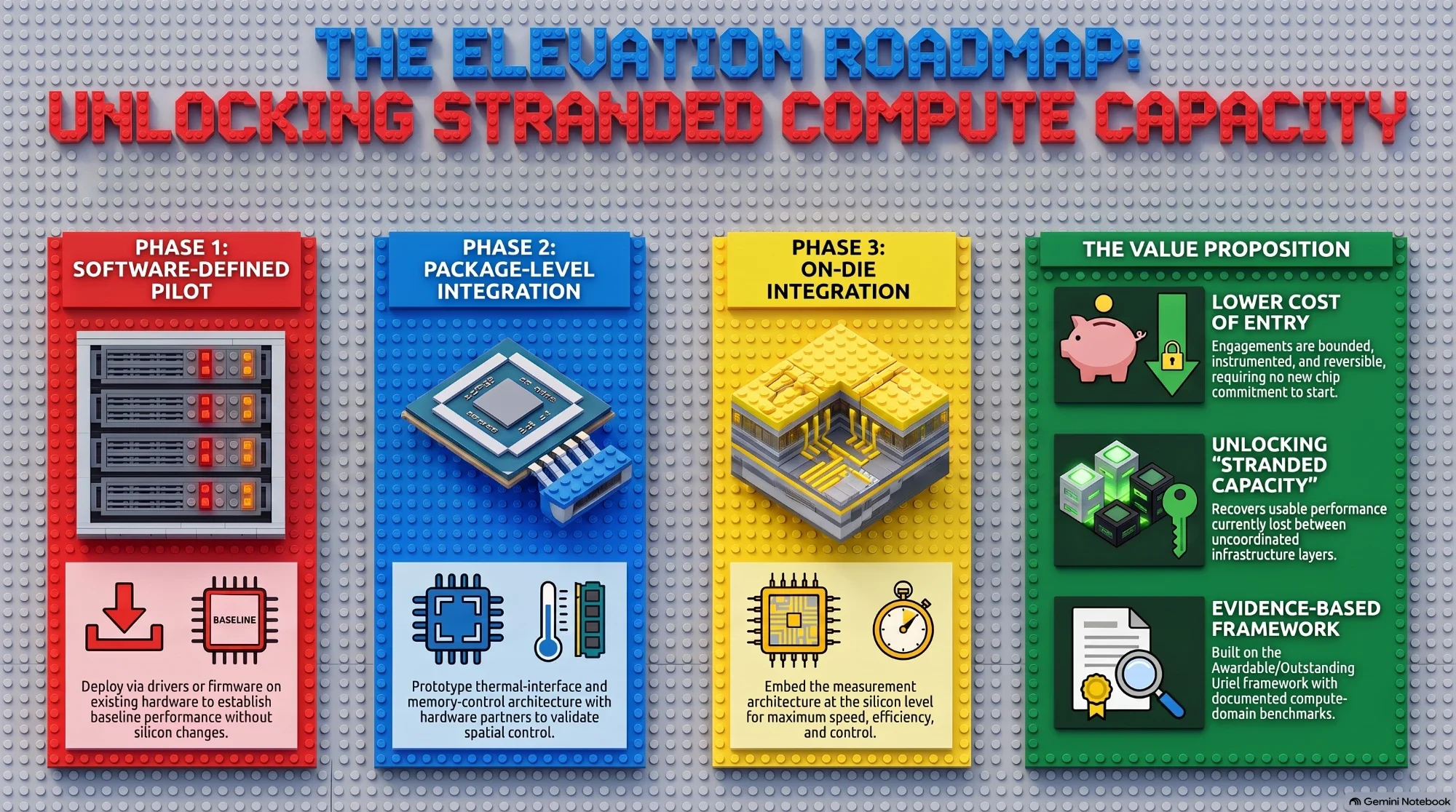
Elevation is structured as a staged program.
Phase 1: Software-defined pilot. Deploy the control and profiling layer through drivers or firmware on existing hardware. Establish baseline power, temperature, throttling, utilization, refresh, and throughput measurements. Run controlled comparisons without changing the silicon.
Phase 2: Package-level integration. Prototype the thermal-interface and memory-control architecture with a hardware partner. Validate spatial control, sensor placement, and high-temperature retention behavior.
Phase 3: On-die integration. Embed the measurement and decision architecture at the silicon and memory-controller level for maximum speed, efficiency, and control.
This path lowers the cost of the first decision. A partner does not need to commit to a new chip before determining whether the framework creates value. The first engagement can be bounded, instrumented, reversible, and measured against an agreed baseline.
The organizations that define the next era of compute infrastructure are making architectural decisions now. Elevation does not ask them to accept an inherited claim or an unrelated demonstration.
It asks them to test a specific proposition:
How much usable capacity is already inside your infrastructure—but stranded between the layers?
The framework exists. The compute-domain benchmarks exist. The GPU and memory architectures are ready for application-specific evaluation.
The remaining question is who will measure the opportunity first.
Paul Samuel Guarino — Independent Researcher & Inventor Contact: [email protected] Patent family: U.S. Provisional 63/834,399 | U.S. Non-Provisional 19/700,318 | U.S. Provisional 63/937,225