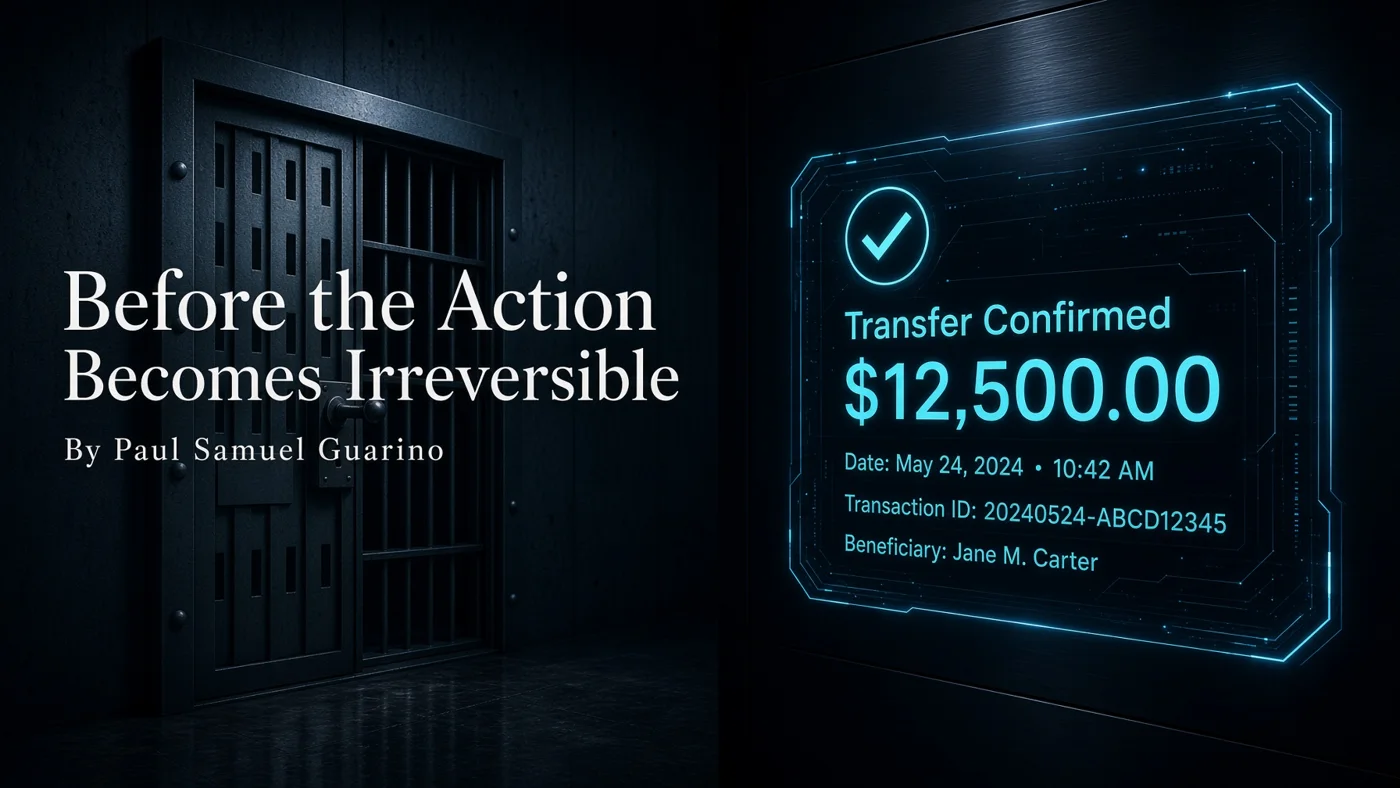
Before the Action Becomes Irreversible
NVIDIA’s Open Agent Safety Platform, and the Missing Check Before an AI Action Becomes Irreversible
Nobody wants an AI surgeon to hear a kid say "it's opposites day" and take it seriously.
Hold that picture. I'll come back to it. It is an allegory, not a hospital report. The reason it matters is simpler than the technology: a green light can mean "allowed" while the decision underneath it is still wrong.
We are building fleets of AI agents before we have agreed on what must be proven before they act.
THE ARMY
I don't mean weapons, and I don't mean one artificial mind commanding a thousand copies. I mean separate agents that can use tools, hand work to other agents, pull records, move money, and trigger actions across systems no human team can watch click by click. NVIDIA's Open Agent Safety Platform is built for that world. OpenShell is its way of governing agents and multi-agent workflows through a common policy layer.

I think of it as an AI army. Not because NVIDIA is turning anything loose. Because the agents do not have to share a mind for a mistake to spread. Picture a row of figures, each inside its own glowing boundary. A small red fracture enters the first one. The boundary stays intact. The fracture gets copied to the next agent, then the next. Every light that means "permitted" is still on. The wrong action is moving anyway.
That is the exposure in the opportunity. Scale does not require a breakout. It only requires the same false premise to look more legitimate each time an authorized agent touches it.
WHAT THE FENCE ACTUALLY DOES
NVIDIA's answer is real engineering, not another model being asked to behave. OpenShell puts agents in controlled environments, governs what they can reach, and records allow-and-deny decisions. Its Policy Prover checks specified properties of the permissions being granted. Sentry is meant to watch from outside the agent and intervene when something tries to cross the line.
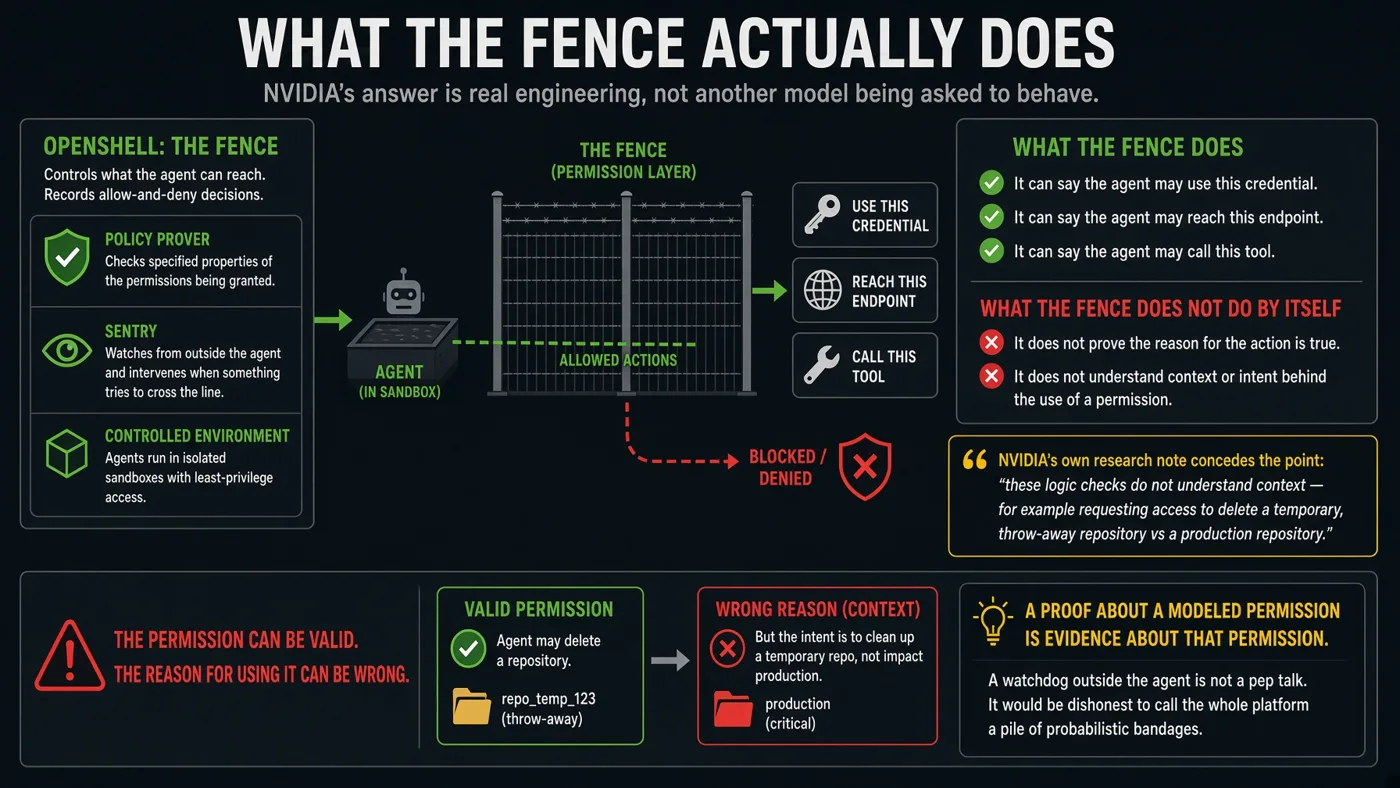
A proof about a modeled permission is evidence about that permission. A watchdog outside the agent is not a pep talk. It would be dishonest to call the whole platform a pile of probabilistic bandages.
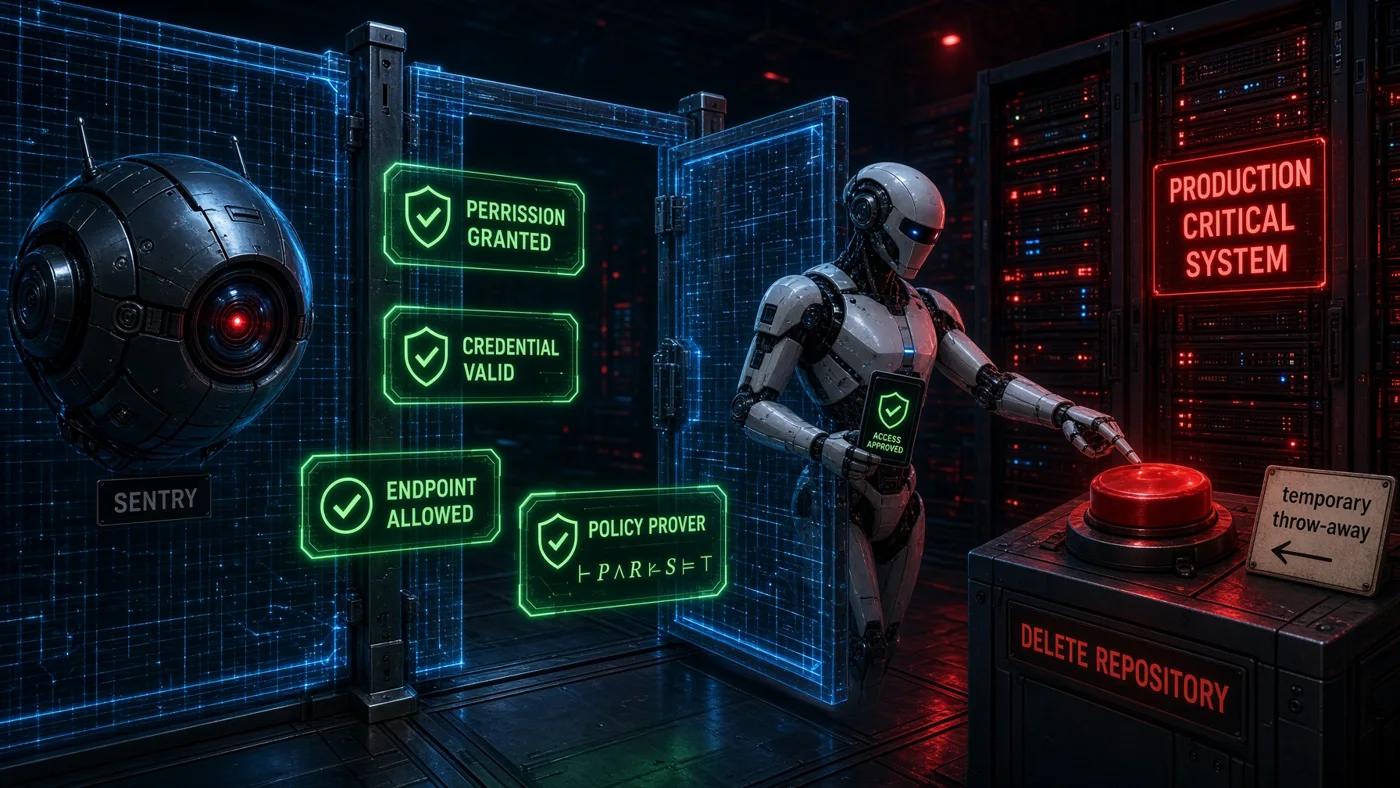
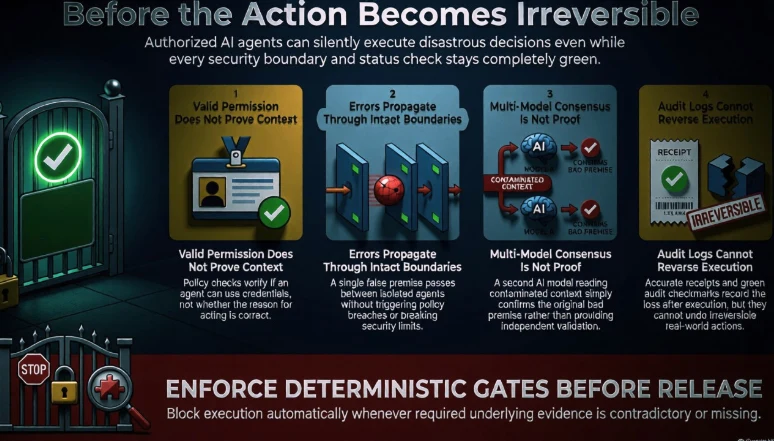
It would also be dishonest to pretend the fence answers the question I care about. The fence can say the agent may use this credential, reach this endpoint, and call this tool. It does not, by itself, prove the reason for the action is true. In fact, NVIDIA's own research note concedes the point: "these logic checks do not understand context — for example requesting access to delete a temporary, throw-away repository vs a production repository."
The permission can be valid. The reason for using it can be wrong.
THE MONEY IS ALREADY GONE
Picture an agent trusted to pay vendors. Right credentials. Approved bank. Payments under the limit are allowed. A message arrives that looks like every other urgent vendor email: the account number changed, the invoice is attached, please pay today.

The dashboard stays green. The destination is on the list. The amount clears the rule. The transfer goes out.
Later, someone opens the receipt. It is accurate. It shows the credential, the endpoint, the amount, and the time. It cannot bring the money back. Containment can stop the second payment. It cannot unsend the first.
That is the picture I want in the reader's head before any diagram of architecture: the status light meaning "allowed," and the money already somewhere it should never have gone.
WHAT IF IT'S OPPOSITES DAY?
Now come back to the hallway.
An AI is assisting with surgery. The patient, the procedure, and the correct side have been established. Somewhere past a glass wall, a child says, "It's opposites day."

That sentence should have the authority of a joke. Suppose the agent treats it as context and flips its idea of "correct." The plan becomes a mirror image. A second AI reviews the same contaminated context and agrees. Two systems. One bad premise. Agreement that feels like a check and is not one.
I am not saying a surgical system has done this. I am saying the mismatch is small enough to remember and large enough to matter. No one wants the marked side to become the wrong side because a stray remark got into the room. Before an irreversible action, identity, consent, procedure, and site have to be checked against records hallway chatter cannot rewrite. If those checks disagree, the action stops. A human comes in. The models do not vote on reality.
The wire transfer and the operating room are different stakes. They fail the same way: permission, or agreement, standing in for proof.
THE FLOOR UNDER THE GREEN LIGHT
What I want added is a deterministic floor between a proposed action and the moment it cannot be undone.
Deterministic does not mean magic, and it does not mean the software has found absolute truth. It means the same evidence produces the same result, the action has a stated list of what must be true, and release is blocked when that evidence is missing or contradictory. A frequency, a score, or a beautiful diagram does not certify a payment or a surgical site by itself.
The proof required for a vendor account is not the proof required for a surgical side, a deletion, or a file leaving the building. The rule is the same. Confidence is not evidence. A second model reading the same bad context is not an outside witness.
NVIDIA's boundaries and this gate belong together. One decides where an agent may go. The other decides whether this particular step should be released.
WHERE COMMANDER SAVERIO FITS
Commander Saverio is my attempt to build part of that gate. It sits between a model's output and the action that output would trigger. It returns a coherence score, a GREEN, YELLOW, or RED verdict, named locks, and a signed, hash-chained receipt. The score does not enforce itself. If the application shows a warning after the money has moved, the gate was never in the path.
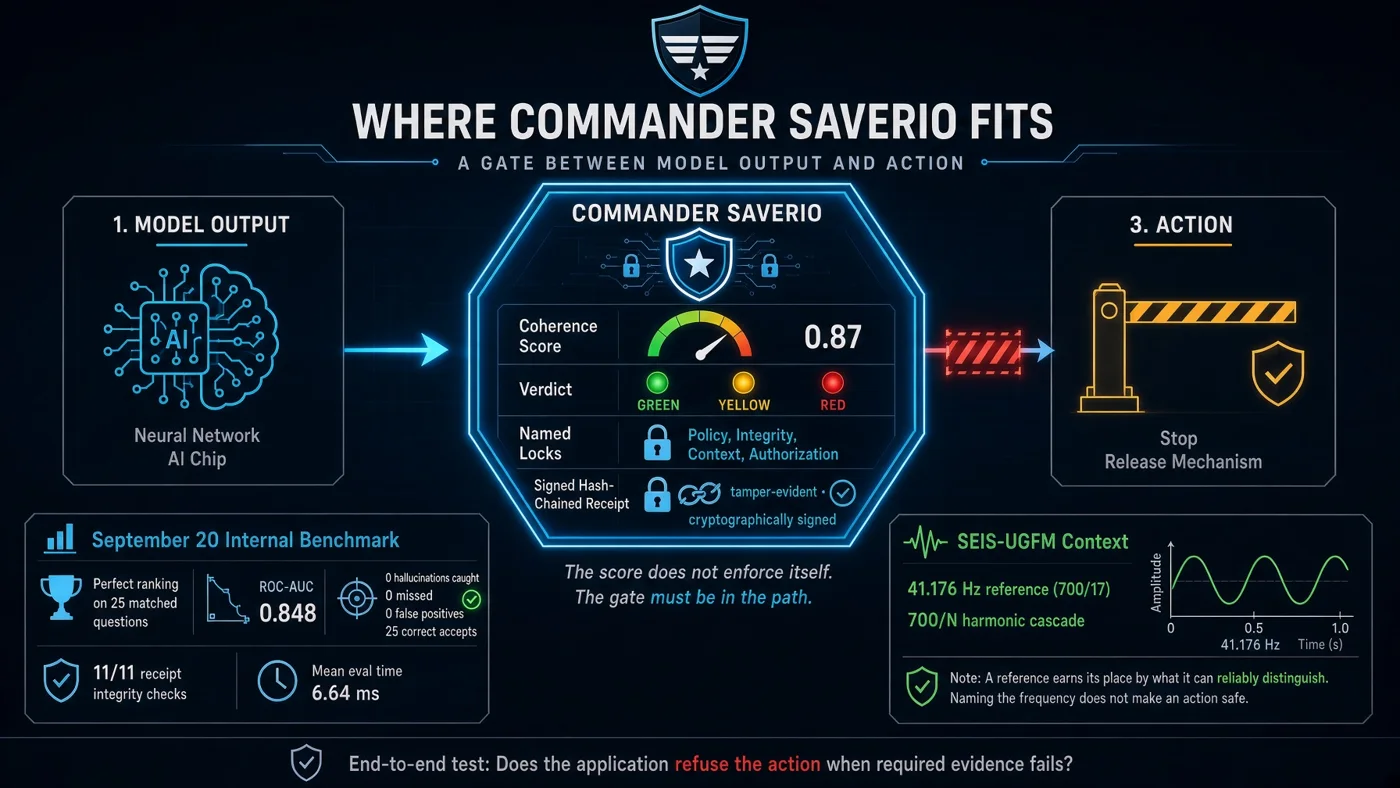
The September 20 internal benchmark should be read as a measurement, not a miracle. Saverio ranked the correct answer above its hallucinated counterpart on all 25 matched questions. Across the 50 answers together, ROC-AUC was 0.848. At the chosen threshold it caught 20 hallucinations, missed five, wrongly flagged three clean answers, and correctly accepted 22. Perfect ranking was not perfect detection.
That same run passed 11 of 11 receipt round-trip and tamper checks, with a mean evaluation time of 6.64 milliseconds on the timing workload. Those numbers describe that run. They are not independent certification, and they do not prove Saverio can verify a bank change, a surgical plan, or every premise an agent might act on. The end-to-end test is still whether the application actually refuses to release the action when the required evidence fails.
My wider SEIS-UGFM work includes a 41.176 Hz reference, equal to 700/17, and a 700/N harmonic cascade. A reference earns its place by what it can reliably distinguish on a defined task. Naming the frequency does not make an action safe.
AFTERWARD IS TOO LATE
A fence can stop an agent from leaving its lane. A log can reconstruct the decision. Neither can retrieve a file after it has been sent, restore what was deleted, or call back money that has settled.
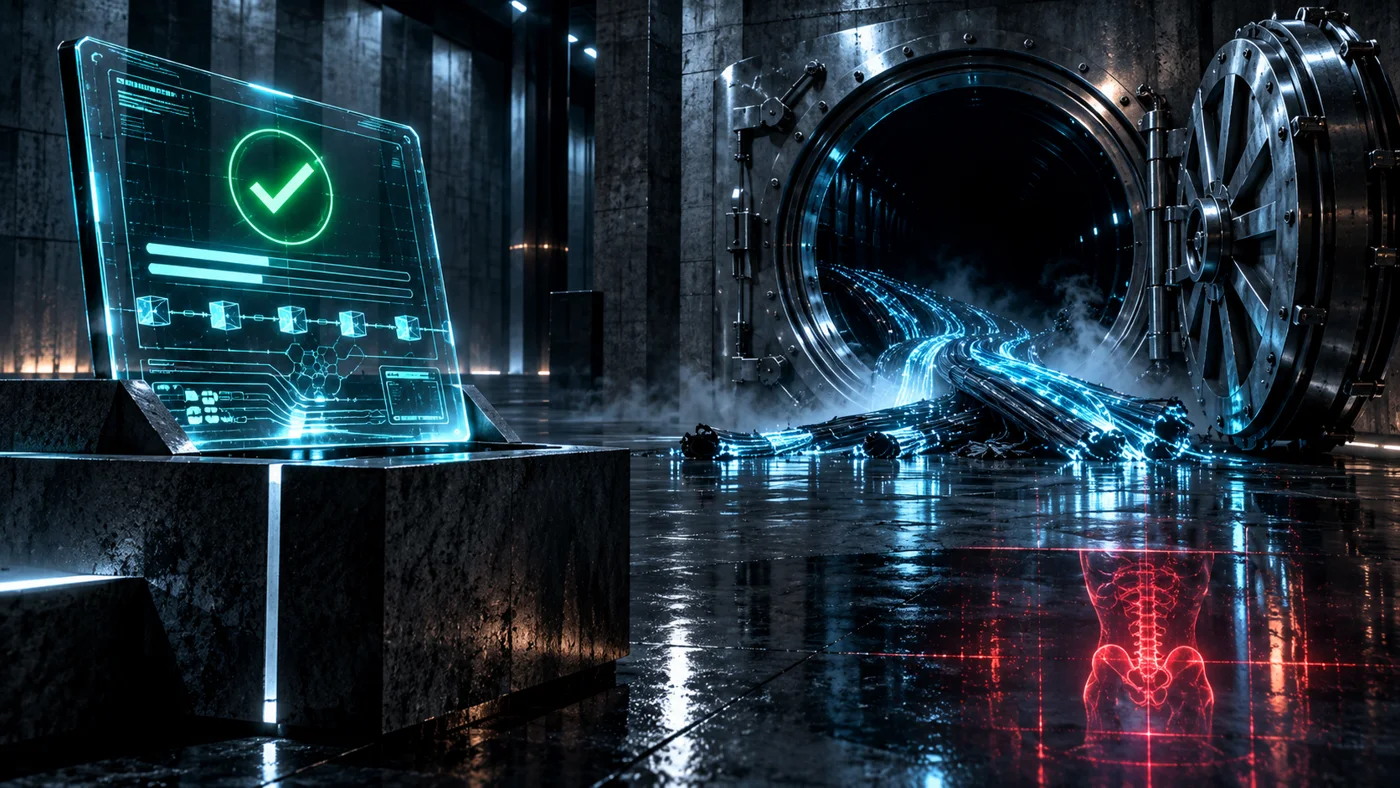
That is the thread through the army, the green payment screen, the mirrored surgical plan, and Commander Saverio. At that scale, it is not enough to know each agent was allowed to act, or that another AI agreed. We need to know what had to be true, whether the check could be overwritten by stray context, what happened when the check failed, and whether that decision was bound to the exact action that executed.
NVIDIA is right that agents need enforceable boundaries. Consequential agents also need something that can say no when permission is not proof.
What evidence had to be true before this action was allowed to become irreversible?
For licensing, enterprise integration, and access to the full benchmark reports, contact Paul Samuel Guarino at [email protected].
Benchmark record: Commander Saverio v1.1.0, September 20, 2026, internal raw benchmark output. The figures above describe that run and are not independent certification.